
School admission management software
How to Nurture Prospective Parent Leads from Open House to Final Payment
Most schools lose prospective families between the open house and the application, not because of the school but because nobody followed up. Here is a simple nurture sequence that keeps families warm until the first fee is paid.
The Onflows team3 min read
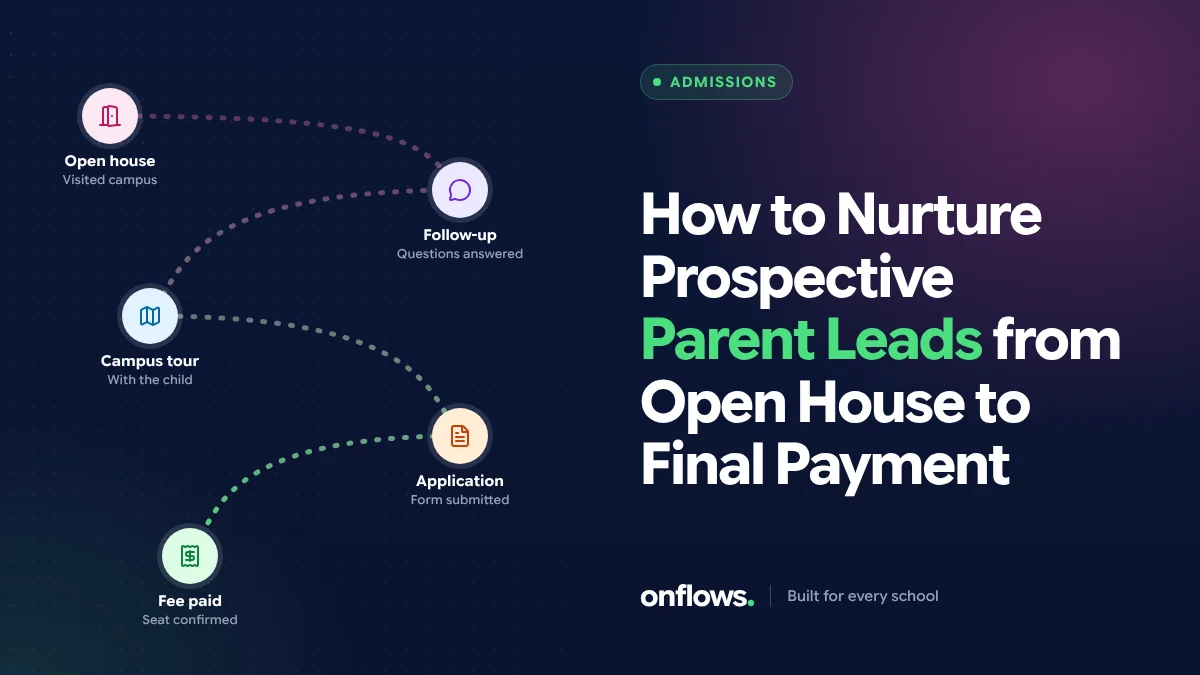
A family comes to your open house, likes the school, takes a brochure, and goes home. Three other schools are on their list. Two of them call the next day. You do not. In March, the family enrols elsewhere and you never learn why.
Admissions are a sequence, not an event. The schools that fill their seats are usually not the ones with the best open house. They are the ones that follow up.
The stages
- Inquiry. A call, a website form, a walk-in.
- Visit. An open house or a campus tour.
- Application. The family formally applies.
- Assessment or interview, if your school uses one.
- Offer.
- Acceptance and first payment.
At every stage some families drop out. The goal is to lose only the ones who were never a fit.
Record every inquiry with its source
Every inquiry goes into one list, with where it came from: website, referral, newspaper, walk-in. By the end of the season you know which sources produce admissions, not just inquiries. See reading year-on-year application trends.
A nurture sequence
| When | What |
|---|---|
| Same day as inquiry | Acknowledgement, with the open house date and a link to apply |
| Day after the visit | Thank-you from a named person, with answers to anything asked |
| Three days after the visit | A short story about the school: a project, a result, a teacher |
| One week after | A reminder of the application deadline and how to apply online |
| Two weeks after, if no application | A personal call |
| After offer | Clear next steps, the fee structure, the acceptance deadline |
| After acceptance | Welcome, orientation date, what to expect |
Keep each message short and personal. A message signed by the admissions coordinator, by name, gets more replies than one from "The School".
The personal call matters most
Automated messages keep the school in mind. The call wins the family. Ask what they are deciding between, and what would help them decide. Often it is a practical question nobody answered: transport, timings, a sibling.
Make the application easy
A nurture sequence that ends in "please visit the office to collect a form" undoes itself. The application should be online and finishable on a phone. See turning website inquiries into enrolled students without paperwork.
After the first payment
The relationship is not done when the fee is paid. The months between acceptance and the first day are when families have second thoughts. See sending welcome kits and orientation details automatically.
Where Onflows fits
In Onflows, every inquiry and application lives in one admissions list with its status, families complete the application online by link, and the admitted applicant becomes the student record. Messages to families use the school's own templates. Admissions are on the free plan. See the features page.
Frequently asked questions
How many follow-ups are too many?
More than one a week. After the personal call, stop unless the family asks.
Should we follow up families who chose another school?
Once, politely, asking why. The answers are valuable.
What is a good conversion rate from inquiry to admission?
It varies widely by school and market. Track your own rate year on year; the trend matters more than the number.
See admissions in Onflows, or create your school free.
Topics: School admission management software, Admissions, School management software, Communication, Free school admission management system