
School management software
Securing Student Allergies, Immunization Records and Infirmary Visits Online
A student's allergy note is useless in a file cabinet when they collapse in the canteen. Here is how a school can keep health records online so the right people can act in seconds, while everyone else cannot see them at all.
The Onflows team3 min read
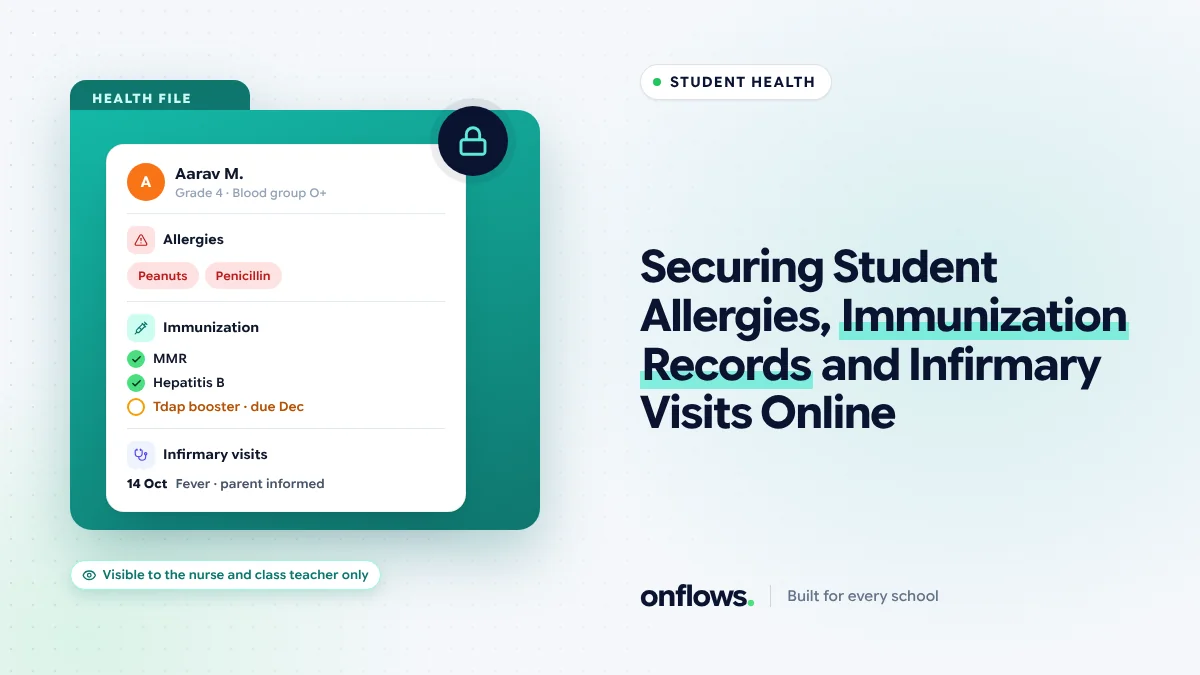
The admission form asked about allergies. The parent wrote "peanuts, severe". The form went into a file. Three years later, on a school trip, a teacher who has never seen that file hands the student a snack.
Health records have two requirements that pull in opposite directions. The people responsible for a child need the information instantly. Everyone else must not see it at all. Paper fails the first. A shared spreadsheet fails the second.
What to record
Critical alerts (shown to anyone responsible for the child):
- Severe allergies and what to do.
- Conditions needing emergency action: asthma, epilepsy, diabetes, heart conditions.
- Where the medication is kept (an inhaler in the bag, an auto-injector at the infirmary).
Medical history (nurse and leadership only):
- Immunisation record.
- Ongoing conditions and treatments.
- Doctor's contact.
Infirmary log (nurse, with a summary to the family):
- Each visit: date, time, complaint, action, whether the family was called.
Who should see what
This is where most systems go wrong. A sensible split:
- Class teacher, trip leaders, canteen staff: the critical alert only, as a short line, for the children they are responsible for.
- School nurse: the full record.
- Principal: the full record, when needed.
- Office staff, other teachers: nothing.
Role-based access is how this is enforced rather than hoped for. See keeping financial and medical records away from staff who do not need them.
Keep it current
Health information changes. A child outgrows an allergy or develops a new condition. Ask families to confirm health details at the start of each academic year, and make it easy to update at any time. The record should show when it was last confirmed.
Immunisation records
Many boards and countries require proof of immunisation at admission. Store the certificate as a document on the student's record, so it is available when the inspector asks and does not need to be collected again. In Onflows, documents are stored against the student in a versioned vault that never hard-deletes.
Trips and events
Before any trip, the leader should get a list of the students going, with critical alerts and emergency contacts. Generate it from the record on the day of the trip, not from a list made a month ago.
Law and consent
Health data about children is special-category data in most data protection laws. Collect only what you need, explain why, get consent where required, and log who views it. See how to make sure your school software complies with data protection law.
Where Onflows fits
Onflows holds the student record, guardians, a versioned document vault and an audit trail, with permissions by role. A dedicated health module with infirmary logs and critical alerts is not something Onflows offers today. Schools store immunisation certificates and medical documents in the vault. If a health module would decide your purchase, tell us when you sign up; it shapes the roadmap.
Frequently asked questions
Should allergies be printed on ID cards?
Usually not. It exposes private information to anyone who sees the card. Keep it in the system where the right adults can see it.
How long should health records be kept?
Follow local regulation. Typically until the student leaves, then archived for a defined period.
Can parents update health details themselves?
They should be able to request a change, which the nurse confirms.
See the student record and document vault in Onflows, or create your school.
Topics: School management software, Student records, Health, Privacy, Student safety