AI
Using AI Telemetry to Flag Students Falling Behind Academically
Attendance, homework and marks already tell you which students are slipping, weeks before the report card does. Here is how an early warning system reads those signals, where AI helps, and why a teacher should always make the call.
The Onflows team4 min read
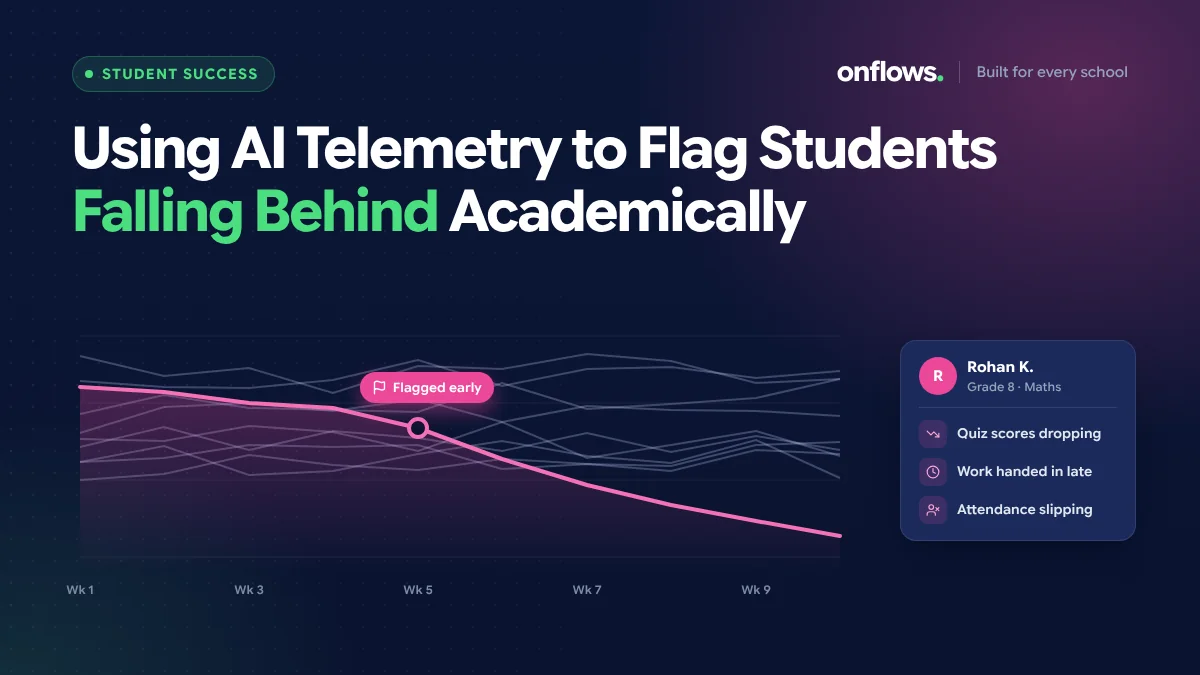
By the time a report card shows a student has fallen behind, the falling happened two months ago. The signals were there earlier: a few more absences than usual, homework that stopped arriving, a test mark that dropped and did not recover. Each one was recorded. Nobody put them side by side.
That is what "AI telemetry" means when it is useful: reading signals the school already collects and pointing at the students a teacher should look at this week.
The signals that matter
Research on early warning systems in schools keeps returning to the same three groups, sometimes called the ABCs:
- Attendance. Not just the percentage, but the trend. A student going from 96% to 85% in a month is a stronger signal than a student who has always been at 88%.
- Behaviour. Incidents, late arrivals, missed submissions. We cover recording these consistently in standardising student behaviour records.
- Coursework. Marks, but also whether homework is being handed in. A missing submission often comes before a falling mark.
A school using a digital student attendance management system and a gradebook already has most of this.
Where AI helps and where it does not
A simple rule catches a lot: flag any student whose attendance dropped more than ten points this month, or who missed three submissions in a row. Rules are transparent and every teacher can understand them.
AI adds value in two places:
- Combining weak signals. A small attendance drop plus one late submission plus a slightly lower test mark may each be noise. Together they can be meaningful. A model trained on past years can weigh them.
- Ranking. A class teacher with forty students needs the five worth a conversation, not a list of twenty flags.
AI does not help with the decision. A flag is a question, not a verdict. The student may be ill, a family may be moving, a sibling may have been born. The teacher who knows the student decides what happens next.
Guardrails worth insisting on
- Explain every flag. "Attendance down 12 points, two homework submissions missing" is actionable. A risk score with no reasons is not.
- Never show the score to the student. A label like "at risk" becomes a self-fulfilling description.
- Review false positives. If the system keeps flagging students who are fine, the rule is wrong.
- Restrict access. Early warning data is sensitive. It should be visible to the class teacher and the people who act on it, not to every staff login. See keeping sensitive records away from staff who do not need them.
What Onflows has today
Onflows records attendance per day, half day or period, holds homework per class and subject, and keeps marks in the gradebook, all against the same student record. The class and student pages put attendance and results side by side so a teacher sees the trend without exporting anything. An automated early warning model is not something we ship; the AI that has shipped is listed on the AI page, and each job there has a person who decides.
That is deliberate. We would rather give a teacher the signals in one place than a score they cannot question.
A simple weekly routine
You can run an early warning process this week without any AI:
- Every Monday, list students whose attendance fell this month.
- Add anyone with two or more missing submissions.
- The class teacher picks the ones to talk to, and records that the conversation happened.
- Families are told what the school noticed and what it is doing. Parents who can see grades and attendance themselves are usually allies here; see how transparent access raises parent satisfaction.
Frequently asked questions
Is it ethical to predict which students will struggle?
It is ethical when the prediction leads to support and a person reviews it. It is not when it leads to labels, streaming or exclusion without a human decision.
How early can a system flag a student?
Attendance trends show within two to four weeks. Marks take longer because tests are less frequent.
Do we need AI for this?
No. Clear rules on data you already have will catch most cases. AI helps with ranking at scale.
See what the AI in Onflows does today, or create your school and start recording attendance against the student record.
Topics: AI, Student attendance management system, Automated school grading system, Student success, School management software