
Parent teacher communication app
Logging Positive Classroom Contributions to Keep Parents Informed
Most messages from school to home are about problems: absences, fees, incidents. Here is how to log positive classroom contributions and share them with families, why it changes behaviour, and how to keep it fair across the class.
The Onflows team3 min read
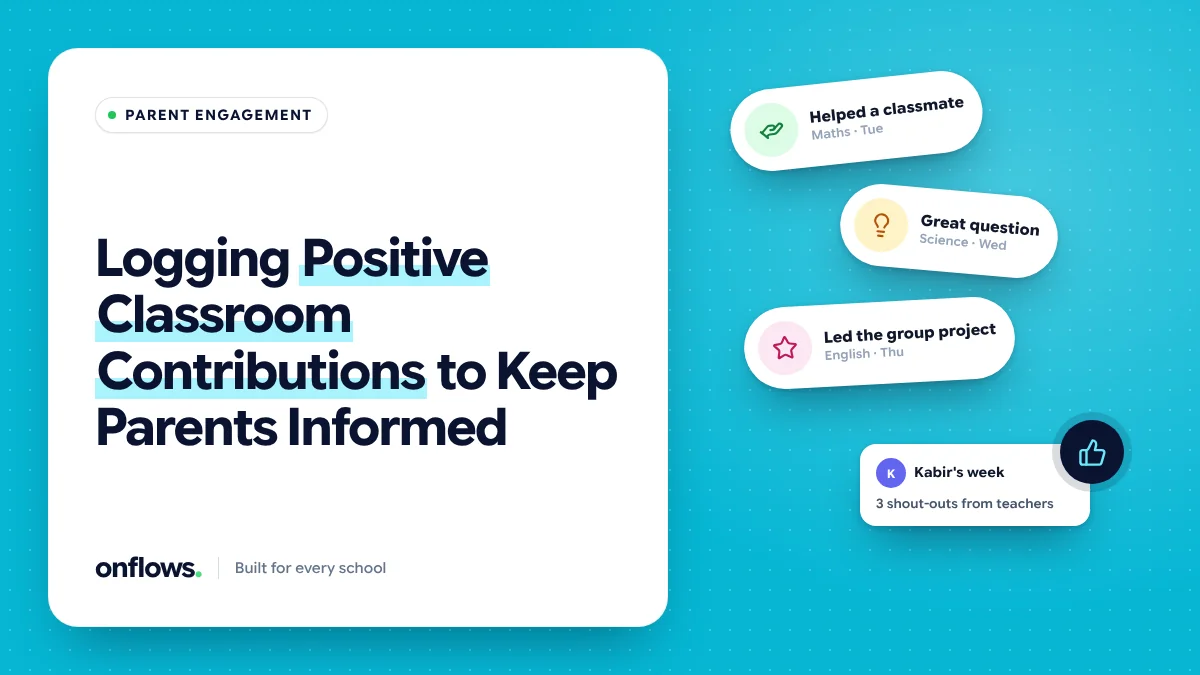
Think about the last ten messages a typical family received from school. A fee reminder, a change in timing, an absence alert, a circular about uniforms, maybe a note about a missed homework. If the family hears from school, it is usually because something needs fixing.
A single message saying "Kabir explained the experiment to the whole class today, and did it brilliantly" changes how that family reads every other message.
Why positive messages work
- They change the relationship. A parent who has heard good news is more receptive when a problem comes up.
- They reinforce the behaviour. A student who knows their effort was noticed and shared tends to repeat it.
- They reach students who are rarely praised. Not the topper, but the quiet student who helped a classmate.
- They cost almost nothing. A sentence, a minute.
What to recognise
Effort and contribution, not just results:
- Explaining something to a classmate.
- Asking a question that helped the whole class.
- Improvement, even if the mark is still low.
- Kindness, leadership, responsibility.
- Persistence on something difficult.
Make it specific
"Good work today" is pleasant and forgettable. "Diya rewrote her essay twice and the second draft was much clearer" tells the parent what happened and gives them something to talk about at dinner.
Keep it fair
The risk with recognition is that the same few students get it every time. Two simple rules:
- Track who has been recognised. Once it is logged, a teacher can see which students in the class have not had a positive note this term.
- Aim for every student, every term. Not as a quota, but as a habit of looking.
Log it, then share it
A positive note that lives only in a message is lost when the student moves to the next class. Logging it against the student's record means:
- The next teacher sees what the student does well.
- Patterns show: a student recognised often for helping others might be a good peer mentor.
- The record is balanced. Behaviour records that only hold incidents give a one-sided picture; see standardising student behaviour records.
Sharing with families
Send it to the guardian directly, not in a class group, so it is personal and does not compare children publicly. The tone should be warm and short.
Where Onflows fits
Onflows sends messages to chosen families with the school's own templates, and every student has their guardians on the record. A dedicated recognition log with points or badges is not a feature we offer today; teachers send the note as a message to the family. If a recognition module would decide your purchase, tell us when you sign up; it shapes the roadmap.
Frequently asked questions
Should recognition be public in the class?
Sometimes. A note home is private; a mention in assembly is public. Use both, and be careful with students who dislike attention.
Do points and badges help?
For younger students, often. For older students, a specific sentence usually means more than points.
How often should a teacher send positive notes?
A few a week per class is enough to change the culture without becoming noise.
Topics: Parent teacher communication app, Recognition, Parents, Students, Communication