
School management software
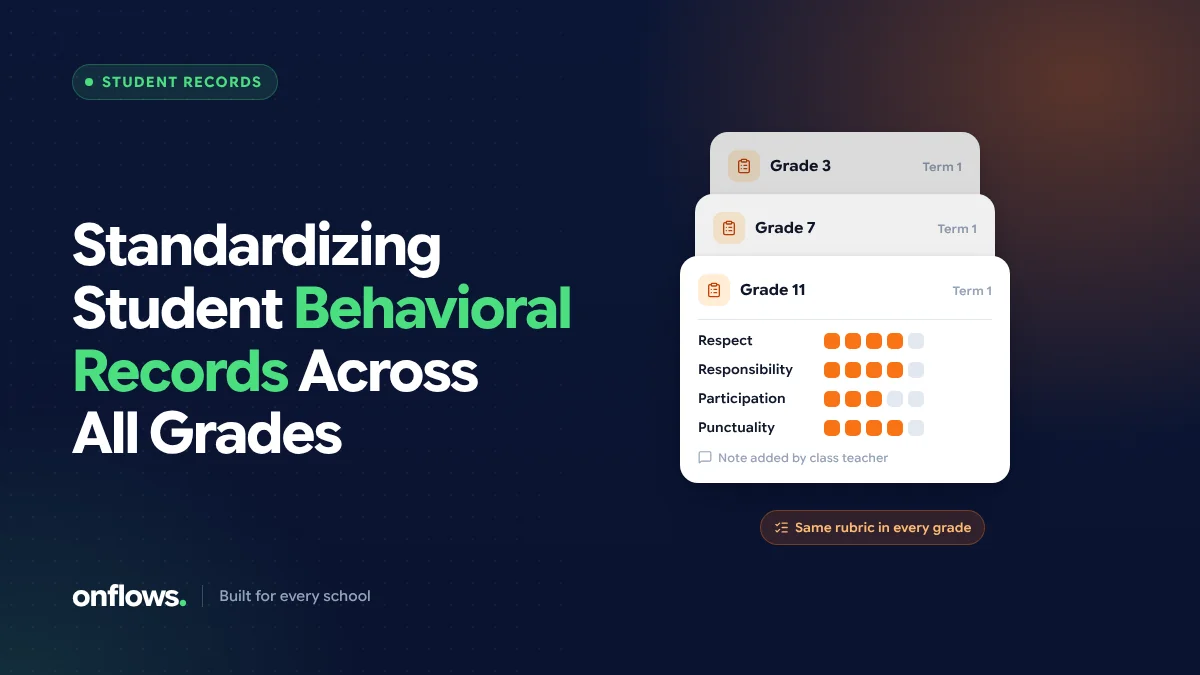
Standardizing Student Behavioral Records Across All Grades
When every teacher records behaviour their own way, the same incident gets a different response in Class 4 and Class 9. Here is how to build a consistent behaviour record, fair to students and useful to the people who act on it.
The Onflows team3 min read
One teacher writes "disturbed the class" in a diary. Another sends a note home. A third reports to the coordinator, who writes it in a register that nobody else reads. At the end of the year, when a parent asks why their child was suspended, the school has three versions of the story and no pattern.
Behaviour records are one of the most important records a school keeps, and one of the least consistent. Standardising them is mostly a policy job, with software as the place the policy lives.
Why consistency matters
- Fairness. Two students who did the same thing should face the same response, whichever teacher saw it.
- Patterns. A single incident is a moment; five in a month is a signal. You only see the pattern if the incidents are in one place. See flagging students who are falling behind.
- Defensibility. If a decision is challenged, the school needs a dated, factual record.
- Continuity. A new class teacher in September should not start from nothing.
Build the categories first
Agree a short list of categories across the school. For example:
- Late arrival
- Uniform or equipment
- Disruption in class
- Unkind behaviour towards another student
- Bullying (repeated, deliberate)
- Damage to property
- Safety risk
Each category has a severity and a standard first response. Seven categories is enough. Forty is a spreadsheet nobody uses.
Write facts, not labels
The record should say what happened, not what kind of child it was:
- Good: "Pushed a classmate on the stairs at lunch, 14 Oct. Classmate unhurt."
- Not good: "Aggressive student. Always causes trouble."
Facts can be checked and reviewed. Labels follow a child for years.
A standard incident note
Every incident, whoever records it, carries the same fields:
- Date, time and place.
- Category.
- What happened, in facts.
- Who saw it.
- The action taken.
- Whether the family was told, and how.
- A follow-up date, if one is needed.
Record the good too
Behaviour records that only hold incidents give a lopsided picture. Recording positive contributions, and telling families about them, changes how students and parents see the whole system. See logging positive classroom contributions so parents hear the good news.
Who should see what
Behaviour records are sensitive. A sensible split:
- The class teacher and the student's subject teachers see the incidents for their students.
- The coordinator and principal see the whole school.
- Families see what concerns their child, and how it was resolved.
- Office staff who do not work with the student see nothing.
See keeping sensitive records away from staff who do not need them for how role-based access works.
Where Onflows fits
Onflows holds the student record, guardians, attendance, and an audit trail of who changed what. A structured behaviour log with categories and incident notes is not a feature we offer today. Schools record notes against the student and use messages to families for the parent conversation. If a behaviour module would decide your choice, tell us when you sign up; it shapes the roadmap.
Frequently asked questions
How long should behaviour records be kept?
Follow your local regulation. Many schools keep minor incidents for the academic year and serious ones until the student leaves, then archive.
Should students see their own record?
Older students, yes. It helps them understand decisions and correct errors.
Do younger classes need a different system?
The same system, with simpler categories and more emphasis on positive notes.
See what the student record holds in Onflows, or create your school.
Topics: School management software, Student records, Discipline, Student success, Parents