
School fee management software
A Complete Guide to Digital Fee Management Under New State Regulations
Many Indian states regulate what private schools may charge and how fees are disclosed and receipted. How digital fee management helps a school stay transparent and ready for scrutiny, with practical record-keeping steps that apply whichever state you are in.
The Onflows team4 min read
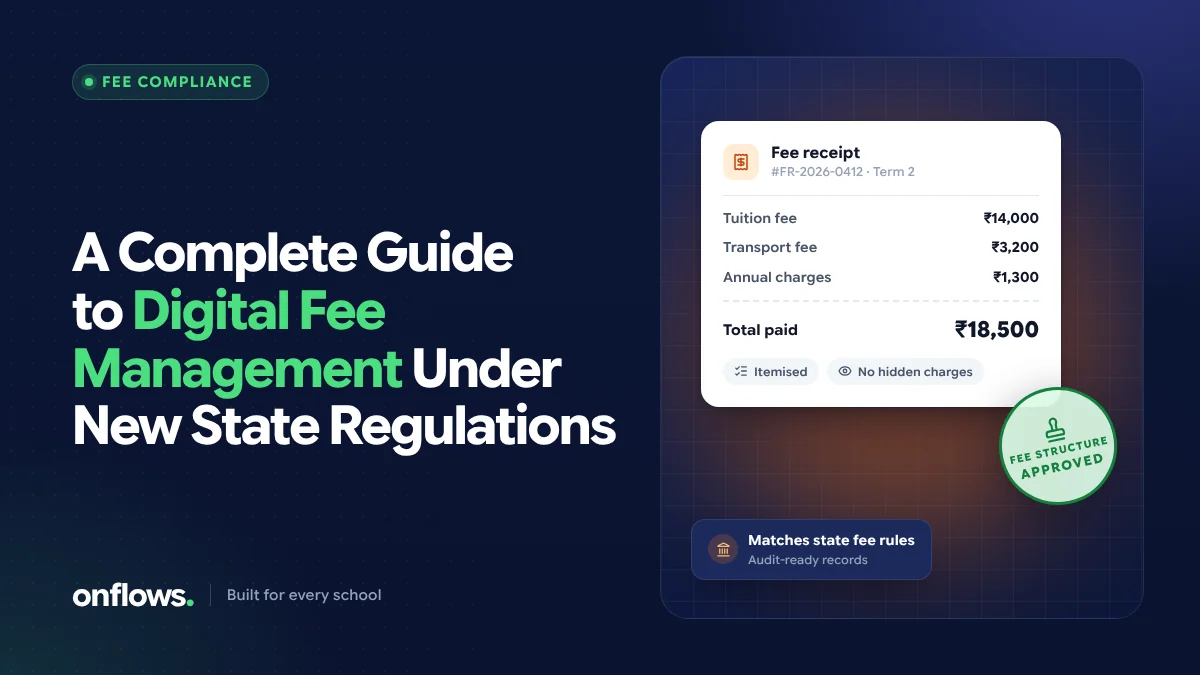
School fees are one of the most regulated parts of running a private school in India. Several states have laws that govern how private unaided schools set, disclose and change their fees, often with a committee that can review them and powers to act on complaints. Rules continue to evolve, and courts have weighed in on fee disputes more than once.
This guide is not legal advice, and the rules differ from state to state. What it does is set out the record-keeping practices that make a school's fees transparent and easy to defend, whichever state you are in, and how school fee management software supports them.
The landscape, in brief
Examples of state laws in this area include the Tamil Nadu Schools (Regulation of Collection of Fee) Act, 2009, the Maharashtra Educational Institutions (Regulation of Fee) Act, 2011, the Rajasthan Schools (Regulation of Fee) Act, 2016, the Gujarat Self Financed Schools (Regulation of Fees) Act, 2017 and the Uttar Pradesh Self-Financed Independent Schools (Fee Regulation) Act, 2018. Other states regulate fees through education acts, rules and government orders. Each sets its own thresholds, procedures and committees.
Across these, a few themes recur:
- Disclosure: the fee structure should be published or made available to parents in advance.
- Approval or limits: some states require fees, or increases above a threshold, to be approved or justified.
- Defined heads: fees should be charged under declared heads, not invented charges.
- Receipts: every payment should be receipted.
- Records: the school should be able to show what it charged and collected, and why.
Always check the current act, rules and orders for your state, and take advice from someone who knows them.
Practice 1: One published fee structure per class
Set up your fee structure once, per class, with every fee head named and every instalment dated. That structure should be the same one you publish to parents and the one your software uses to calculate dues. If the published structure and the billed amounts come from two different documents, they will drift.
Practice 2: Every discount and concession recorded with a reason
Sibling discounts, staff ward concessions, scholarships and fee waivers are legitimate, but they must be traceable. Record each one against the student, with the reason and who approved it, rather than simply charging a lower amount.
Practice 3: A receipt for every payment, numbered and itemised
Each receipt should show the student, the fee heads paid, the amount, the method and a unique serial number. Handwritten receipt books make this hard to audit; software-generated receipts make it automatic. Our fee receipt format lists the fields to include.
Practice 4: Corrections, not deletions
If a payment is recorded wrongly, the correction should be a visible reversal or refund, not a deletion. A ledger where entries disappear cannot be trusted by an auditor or a fee committee. In Onflows, money records are corrected by a reversal or refund rather than erased.
Practice 5: Changes to the fee structure are dated and kept
When fees change for a new academic year, keep the previous structure. If a question arises about what was charged in an earlier year, you should be able to show the structure in force at the time.
Practice 6: An audit trail of who did what
Who created the fee structure, who applied a discount, who recorded a payment, who reversed one? An audit trail answers these questions instantly. We explain more in audit trails for board inspections.
How to automate school fee collection, transparently
- Enter the fee structure per class, with heads and instalments.
- Record concessions per student, with reasons.
- Let the software calculate what each student owes.
- Issue numbered receipts for every payment.
- Send dues reminders from the ledger, not from a separate list.
- Close each month with collection and dues reports.
In Onflows, Fees covers fee codes and instalments per class, discounts, what each student owes and receipts. Onflows does not process payments itself: there is no payment gateway, so money arrives the way it does today and is recorded against the student. Fees is part of the Pro plan; see pricing.
For the practical side of fee day, see how to prevent long queues on fee collection day.
Frequently asked questions
Is there a law that regulates private school fees in India?
There is no single national law; several states have their own fee regulation acts, and others regulate fees through education acts, rules and orders. Check the rules for your state.
What fee records should a school keep?
The fee structure for each academic year, every concession with its reason, every receipt, every correction, and reports of collection and dues. Keep them in a form that can be produced on request.
Can software make a school compliant?
Software cannot decide whether a fee is permitted; that is a legal question for your state. What it can do is make your fees consistent, receipted, traceable and easy to show.
Keep your fee records clean from the first receipt. Create your school on Onflows.
Topics: School fee management software, How to automate school fee collection, School ERP software in India, Compliance